
Thousand Oaks is a mid-size suburban city in Ventura County's Conejo Valley, with a population in the mid-120,000s, a median household income around $135,000, and one of the lowest violent crime rates of any California city its size. The housing market as of August 2026 shows a median sale price of $985,000 and a median of 34 days on market, so buyers who come in prepared move faster and win more often. If you're planning a relocation here, the decisions you make in the first 60 days set the tone for everything that follows.
Why Thousand Oaks Stands Out in Southern California
I've helped hundreds of relocating clients land in the Thousand Oaks/ Conejo Valley areas, and the question I hear most often is: "Why Thousand Oaks specifically?" Here's the honest answer.
This city punches well above its weight on quality-of-life metrics. World Population Review reports a median household income of $135,603 and a per-capita income of $75,579 for Thousand Oaks, placing it significantly above national norms. Global headquarters for Amgen and other biotech companies are a strong draw as well. That income level correlates directly with well-funded public amenities, well-maintained neighborhoods, and a strong local services ecosystem.
On safety, the numbers are compelling. OpenCrime's analysis of 2024 data gives Thousand Oaks a safety grade of "A" with a violent crime rate of just 102.2 per 100,000 residents. For context, Ventura County recorded 16.67 crimes per 1,000 residents in 2024, ranking it the safest large county in California that year. A March 2026 report on 2025 Sheriff's Office data did note a roughly 4% uptick in crime in sheriff-patrolled areas of the county, so I always tell clients to look at the trend, not just a single year's snapshot. Thousand Oaks, as an incorporated city with its own policing, operates in this broader environment but has historically tracked well below state averages.
The community composition matters for relocation planning too. Recent demographic data puts the median age at 44.9 years, which tells you something about who your neighbors will be: established homeowners, mid-career professionals, and families with school-age children rather than a transient renter base. About 70.8% of occupied homes in Thousand Oaks are owner-occupied, one of the stronger homeownership rates you'll find in any Southern California city of this size.
Check out our community page “5 Things Every Buyer Needs to Know before Moving to Thousand Oaks”.
The Outdoor Lifestyle Factor
One thing that surprises relocating buyers who've only seen Thousand Oaks on a map: this city is surrounded by open space. Regional preserves, hiking trails, and parks are woven into the fabric of daily life here in a way that's unusual for a suburb this close to Los Angeles. If your current city requires a two-hour drive to reach a trailhead, that changes when you live here. Lifestyle rankings consistently cite outdoor access as one of Thousand Oaks' top quality-of-life drivers, and in my experience, it's one of the first things clients mention after their first month in the area.
The Commuter Reality
Thousand Oaks sits roughly 35 miles northwest of downtown Los Angeles via the 101 Freeway. That commute can range from 45 minutes to well over 90 depending on time of day and direction, so I always walk my clients through the math on their specific work location before we narrow down neighborhoods. Many residents in Thousand Oaks work in biotech, tech, entertainment, and professional services elsewhere in the region and treat the city as a quieter home base. If your employer offers hybrid or remote flexibility, the commute calculus changes significantly. This is a conversation worth having early in your relocation process, not after you've already chosen a street.
Understanding the Thousand Oaks Housing Market Before You Buy
Recent local market data shows Thousand Oaks' median sale price at $985,000, with homes spending a median of 34 days on market. That's a competitive environment: 308 homes sold in the trailing 90 days, with 288 active listings and 102 new listings added in the last 30 days alone. Buyers who arrive without pre-approval letters, without a clear sense of their must-haves versus nice-to-haves, and without a local agent who knows the micro-pockets tend to lose the first two or three homes they want.
If you're comparing Thousand Oaks to neighboring Conejo Valley communities, here's how the numbers stack up:
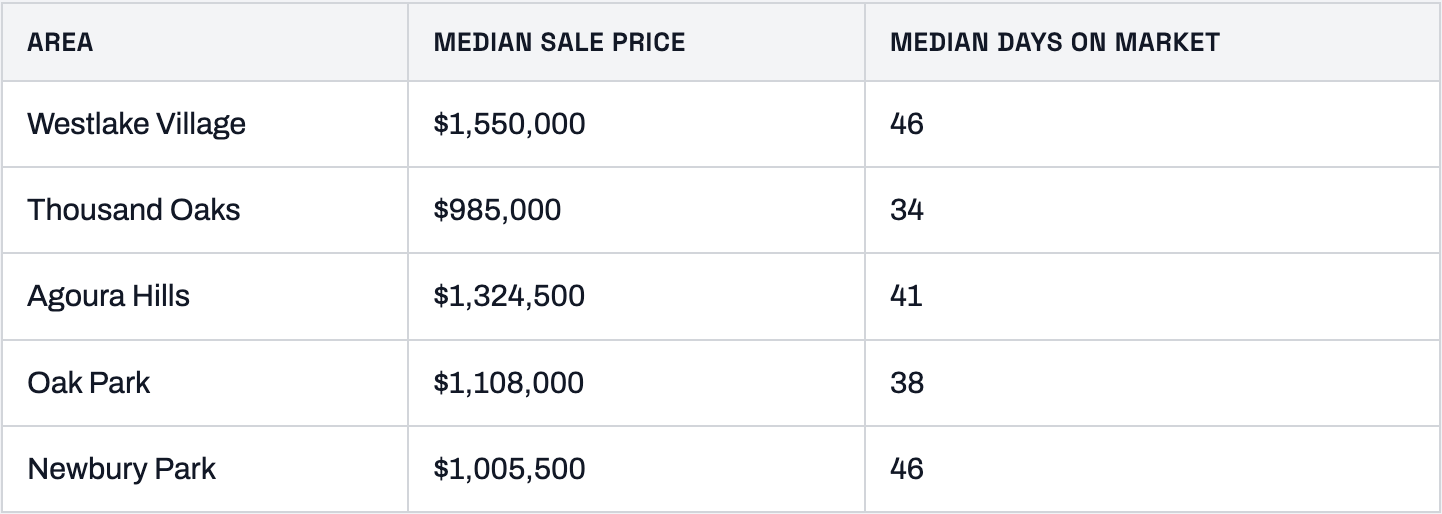
These are area-level medians from aggregated public listing data as of August 2026. An individual home's value depends on condition, street, build year, lot size, and timing, so treat these as orientation points rather than appraisals. What this table tells you is that Thousand Oaks offers the most accessible entry point in the Conejo Valley at the median level, while Newbury Park (technically part of the broader Thousand Oaks city limits) and Oak Park follow close behind.
The only way to know what your budget actually gets you on a specific street, in a specific condition, is to run a real comparative market analysis. That's exactly what I do for every relocating client before we ever set foot in a showing.
Renting vs. Buying When You First Arrive
Some relocating buyers benefit from a short rental period to learn the neighborhoods before committing to a purchase. Others are ready to buy immediately and don't want to pay rent while the market moves. Both approaches can work, and the right answer depends on your timeline, your certainty about the area, and your financial position. I walk my clients through both scenarios so they make that decision with clear eyes, not under pressure. If you're weighing this, see my thoughts on relocating to the Conejo Valley from a major metro for more context on how that transition typically plays out.
What the Ownership Rate Tells You About Neighborhoods
With roughly 46,500 households and a 70.8% owner-occupancy rate, Thousand Oaks neighborhoods skew strongly toward long-term residents. Cul-de-sacs, HOA communities, and single-family tracts are common. That matters for a relocating buyer because it affects neighborhood stability, street-level maintenance, and the general feel of daily life. It also means inventory moves at a deliberate pace: owners here don't turn over frequently, so when a well-priced home in a desirable pocket comes to market, it doesn't wait around.
What buyers need to know about School Districts in Thousand Oaks
If you're relocating with children and want to understand the school landscape before you commit to a neighborhood, my team put together a detailed Conejo Valley back-to-school guide for relocating families that covers what you need to know across Westlake Village, Thousand Oaks, and Agoura Hills.
And for a sense of what day-to-day life looks like at the grocery and retail level, the Conejo Valley has seen meaningful new openings recently. My post on new grocery stores in the Conejo Valley covers what Erewhon, Whole Foods Market, and Costco mean for the area's retail landscape.
Your specific home value, neighborhood fit, and purchase timeline depend on your situation. The only way to get a real picture is to sit down with someone who knows this market. That's where my team comes in.
Before you read the FAQ below, I'd invite you to check out what clients have said about working with us on Google and Zillow.
Frequently Asked Questions About Relocating to Thousand Oaks
Is Thousand Oaks a safe place to live compared to other California cities?
Yes, by the available data. OpenCrime's analysis of 2024 figures gives Thousand Oaks a safety grade of "A" with a violent crime rate of approximately 102.2 per 100,000 residents, well below national and California averages. Ventura County as a whole ranked as the safest large county in California in 2024, with 16.67 crimes per 1,000 residents. A 2026 report on 2025 county data noted a modest uptick in sheriff-patrolled areas, so it's worth monitoring trends, but Thousand Oaks has historically outperformed the broader county on safety metrics.
What is the cost of living like in Thousand Oaks?
Thousand Oaks is an upper-middle-income community. Recent data puts median household income at $135,603, well above national norms, and housing costs reflect that. The median home sale price as of August 2026 is $985,000, based on recent local market data. Beyond housing, residents generally find a well-developed retail and services ecosystem, though everyday costs in Southern California run higher than much of the country. Your specific budget picture depends on your housing situation, so I'd recommend a personalized conversation before you set firm expectations.
How does commuting from Thousand Oaks to Los Angeles work?
Thousand Oaks sits roughly 35 miles from downtown Los Angeles via the 101 Freeway, and commute times vary significantly by time of day. Off-peak, the drive can take 45 to 60 minutes; during peak morning or evening traffic, it can stretch well past 90 minutes. Many Thousand Oaks residents who work in LA rely on hybrid or remote schedules to manage the commute. If you're evaluating a specific employer location, I always walk my clients through the drive at the times that actually matter to them before we narrow down neighborhoods.
Are there parks, hiking trails, and outdoor activities near Thousand Oaks?
Outdoor access is one of Thousand Oaks' most consistent quality-of-life advantages. The city is surrounded by regional open-space preserves and trail systems, and residents regularly cite proximity to hiking and nature as a top reason they stay. Lifestyle rankings consistently highlight outdoor recreation as a defining feature of life here. Whether you're a trail runner, a casual hiker, or just someone who wants a park within walking distance of home, the Conejo Valley delivers in a way that's unusual for a suburb this close to a major metro.
What should I know about renting vs. buying a home in Thousand Oaks?
With about 70.8% of homes owner-occupied, the rental market in Thousand Oaks is smaller and less varied than in denser urban areas. Buying gives you stability and locks in your housing cost in a market where prices have remained strong, but it requires preparation: pre-approval, a clear sense of your priorities, and a local agent who knows which pockets are right for your situation. Some relocating buyers rent for six to twelve months to learn the area first. Others are ready to buy immediately. The right approach depends on your timeline and certainty, and it's a conversation worth having before you start touring homes.
Ready to Make Your Move to Thousand Oaks?
Relocating is one of the most consequential decisions you'll make, and the Conejo Valley rewards buyers who come in prepared. Thousand Oaks offers a rare combination of statistical safety, strong community stability, outdoor access, and a housing market that, while competitive, is navigable with the right guidance.
My team at Lydia Gable Realty Group has helped buyers relocate to Thousand Oaks, Westlake Village, Agoura Hills, Oak Park, Newbury Park, and across the Conejo Valley. We know the neighborhoods, the micro-pockets, and the pace of this market. Let's talk about your timeline and what you're looking for. Schedule a consultation with my team here.
About Lydia Gable
Lydia Gable leads the #1 Real Estate Team in Westlake Village and Conejo Valley, helping buyers and sellers navigate one of Southern California's most desirable markets with local expertise, honest guidance, and a track record of results.
Compass · 818.383.4335
Equal Housing Opportunity. Lydia Gable, DRE license on file with Compass. This article is general information only and does not constitute legal, tax, or financial advice. Verify your specific costs and figures with your closing agent, tax advisor, or lender.