
Start with one question and answer: what should a buyer see first when they step inside? If you fell in love with your home for the views, the next buyer may feel the same. So, build the living room around that view, clear the glass, and define one outdoor seating spot. These are presentation choices, not renovations, and they shape how your home reads online, and in person.
How do you stage a Westlake Village home to show off views and indoor-outdoor living?
Staging Westlake Village Homes for views comes down to three moves: arrange the furniture so the first sightline from the entry lands on your strongest window or outdoor space, keep glass and doors visually clear, and define one usable seating or dining spot outside. These are presentation changes, not remodels. In my experience they shape how buyers read the home in photos and during a showing more than any big-ticket upgrade.
In NAR's February 2025 national survey, 83% of buyers' agents said staging made it easier for buyers to visualize a property as their future home. The living room is the first room to stage: 91% of agents in that national survey staged it, ahead of the primary bedroom (83%) and dining room (69%).
Decluttering, furniture editing, lamp placement, clean glass, and one defined outdoor setup are considered part of staging. Whereas replacing windows, moving walls, or rebuilding a patio are capital improvements.
When I walk a Westlake Village seller through the house before we list, I'm not asking "what should we buy?" I'm asking "what is the one thing this home does better than the other 100-plus listings, and how do we stop anything from hiding it?" The answers below are how I approach that.
What does staging Westlake Village homes for views actually involve?
In most homes it involves editing more than adding, though some homes may benefit from full house staging. Choose which view is the star, arrange the room so a buyer sees it first, and remove anything that competes with it or blocks it.
Start with the sightline from the entry
Stand at your front door and look in. Whatever your eye lands on first is what buyers will remember, and what the first photo will show. Arrange the major pieces so that line of sight leads to your strongest window, terrace, yard, or landscape feature. It might be the hills, a canyon, the lake, or a well-kept backyard. The principle is the same. This is a practical recommendation from my own walkthroughs, not a measured Westlake Village return, and I'd rather tell you that plainly. If the view is the headline, as it is for a lot of homes around the lake (I covered why Westlake Village keeps earning lakeside recognition), the layout should deliver it in the first three seconds.
Keep windows and glass doors visually clear
Anything tall in front of a window works against you. A few edits make a visible difference:
Swap tall or bulky pieces for low-profile furniture near the glass.
Keep circulation paths open so buyers can walk toward the view without detouring around a console or chair.
Restrain the window treatments. Open, simple, and clean beats heavy drapery that cuts the frame.
Clean the glass inside and out. Smudges and spots show up in photos far more than people expect.
None of this needs a permit or a contractor. It's presentation.
Float the seating, don't push it to the walls
In a living room that opens to a view, I usually angle a single seating group toward the window and leave a clear walking path behind it. That makes the room feel larger and keeps the glass as the focal point. Fewer, better-scaled pieces beat a full set of furniture every time. Your room's shape and window placement will change the exact layout, which is why I do this in person rather than from a template.
How do you make indoor-outdoor living read in photos and showings?
Treat the threshold as one continuous space: a clear path through the door, a few repeated colors and materials on both sides, and an outdoor area that has an obvious purpose.
Stage the patio, balcony, or yard as a destination
A small, clearly defined seating or dining arrangement tells buyers how the outdoor space works. A bare slab doesn't. An overfilled one doesn't either. The goal is to show circulation, scale, and how the outside connects to the room it opens from. One group, sized to the space, is usually enough.
Repeat a few finishes across the threshold
You don't need new flooring or new doors to make inside and outside feel linked. Repeating two or three colors or materials in textiles, accessories, and furniture on both sides of the glass does most of the work. If the cushions outside echo the pillows inside, the eye reads one space.
Photograph the strongest connection in favorable light
This is where a lot of view homes lose ground. A bright interior with a completely washed-out exterior weakens the story. So does a dramatic exterior with a dark interior. I ask the photographer to test interior exposure, exterior exposure, and the angle where the view is most legible, and I want to see the options before we choose. Lighting matters before the photographer arrives too. Open the blinds, place lamps so no corner goes dark, and keep bulbs consistent so rooms don't look mismatched.
Which staging choices are worth making, and which upgrades can you skip?
Put your effort into decluttering, furniture editing, lighting, clean glass, and one defined outdoor setup. Skip structural or capital work unless you have a reason to do it.
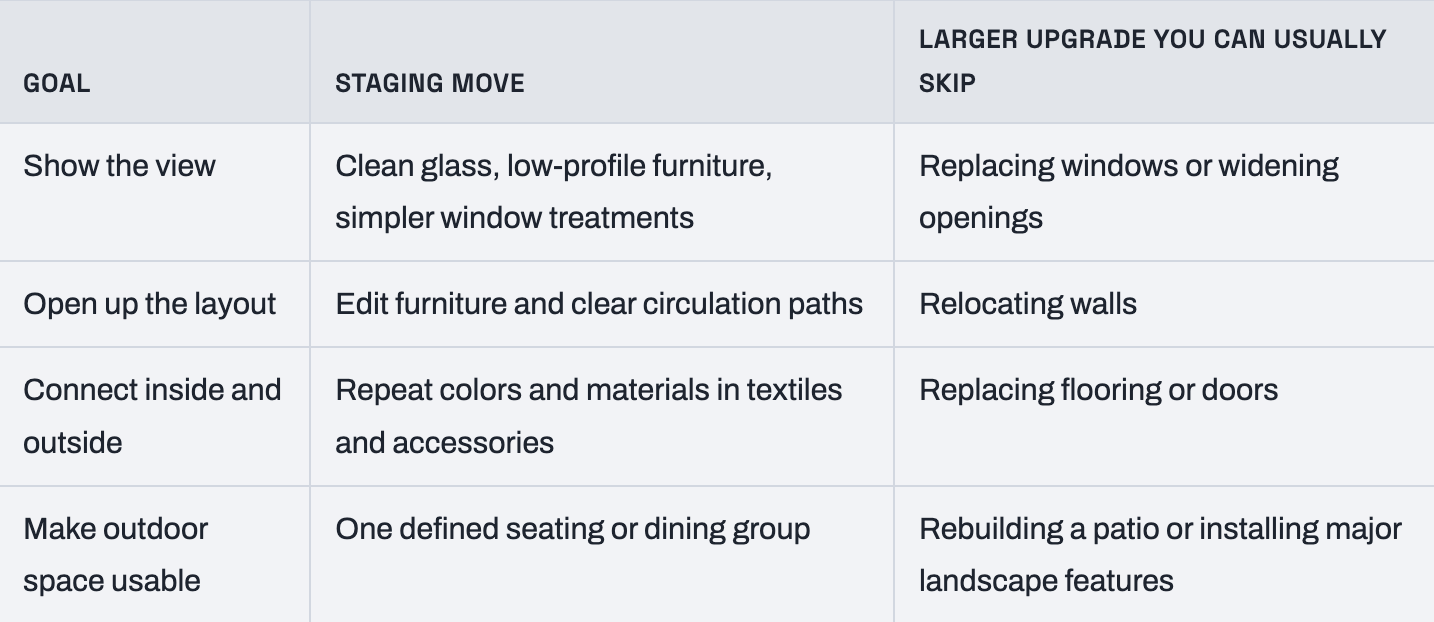
The left two columns are staging. The right column is capital improvement. If you're considering anything in that last column, check with the city's building department before you start, and talk to me first about whether it makes sense for your sale at all.
Which rooms should you stage first?
Start with the living room. In NAR's 2025 Profile of Home Staging, a national survey from February 2025, the living room was the most commonly staged room, followed by the primary bedroom and dining room at 91%, 83%, and 69% of agents, respectively. The same survey found that 83% of buyers' agents said staging made it easier for buyers to visualize a property as their future home. Those are national figures, not Conejo Valley data, but they match what I see: the main gathering space and the view corridor deserve your effort and budget before the decorative touches in secondary rooms. You can read more in NAR's staging research.
What does the Westlake Village market tell you about presentation?
Recent local market data shows a median sale price of $1,775,000 for Westlake Village homes sold in roughly the last 90 days, with a median of 33 days from listing to going under contract. In that same window, 93 homes sold. There are 123 homes for sale now, and 45 new listings came on in the last 30 days.
Those are area-level figures. Your own home's value depends on its condition, street, build year, and timing. What the numbers do tell you is that buyers have a lot to scroll through, and your photos are competing with plenty of other listings. If you want the bigger picture of what draws buyers here, I wrote about what living in Westlake Village is really like.
Is professional staging worth it for a higher-end home?
Sometimes, and it depends on how the house presents today. I haven't found a verified Conejo Valley study that ties staging to a particular sale price, days-on-market change, or return, so I won't assign you a number. What I can do is walk the home, tell you what actually needs help, and tell you what you can handle with the furniture you already own. My team handles home preparation, staging guidance, and marketing together, so the staging plan and the photography plan are built around each other. If you want to see how I think about getting a home ready, my free seller workshops in Westlake Village cover it.
Before the FAQ, if you'd like to hear from people I've worked with, you can read my reviews on Google and Zillow.
FAQ
How should I stage a Westlake Village home so the views stand out in listing photos?
Arrange furniture so the first sightline from the entry leads to your best window or outdoor feature, and keep the glass clean and unobstructed. Then have the photographer test interior and exterior exposure so neither the room nor the view is washed out or dark. I review those test shots with my sellers before choosing the final images.
Should I remove furniture that blocks a view of the lake, hills, canyon, or backyard?
Yes, if a piece sits in front of the view or interrupts the path toward it, move it or replace it with something lower. Furniture is easy to store, and a clear view is one of the most persuasive things a home can show. Keep what you need for the room to still look like it works.
How can I make an indoor-outdoor floor plan feel connected without remodeling?
Repeat two or three colors or materials on both sides of the threshold, keep the path through the door clear, and give the outdoor area a defined purpose. You can do all of that with textiles, accessories, and furniture. You don't need to replace flooring, doors, or windows.
Which rooms should I stage first if I have a limited budget?
Begin with the living room, especially the area facing the view, then the primary bedroom and dining room. That order follows NAR's national February 2025 survey of which rooms agents stage most. A focused effort on the main gathering space usually does more than spreading a small budget across the whole house.
Should I stage the patio, balcony, or backyard for photos?
Yes, with restraint. A small, clearly defined seating or dining arrangement shows buyers how the space functions and how it relates to the room it connects to. Avoid filling it so full that scale and circulation become hard to read.
Staging Westlake Village homes well is mostly about editing, light, and a clear path to the view, not about spending on renovations. Every house is different, and the only way to know which moves your home needs is to walk it together. To start, schedule a consultation with me and the Lydia Gable Realty Group team by calling 818.383.4335, and we'll make a plan before you list.
About Lydia Gable
Lydia Gable leads the Lydia Gable Realty Group, recognized as the #1 real estate team in Westlake Village and Conejo Valley. She helps buyers and sellers with relocation, luxury estates, downsizing, first-time purchases, home preparation, staging, and marketing.
Equal Housing Opportunity. Lydia Gable, Compass, California DRE licensee. This article is general information, not legal, tax, or financial advice; confirm your own numbers with your closing agent, tax advisor, or lender.