*The Pure Water Project* is now underway in the Conejo Valley and reshaping the future of water reliability, sustainability, environmental stewardship, and even real estate conversations throughout the region.
Construction has officially begun on the Pure Water Project, an Advanced Water Purification Facility and related pipeline infrastructure - a massive $466-million regional clean water initiative led by the Las Virgenes Municipal Water District (LVMWD) and the Triunfo Water and Sanitation District through their longstanding Joint Powers Authority (JPA).
The project includes a new 35,700-square-foot advanced water treatment plant at 30800 Agoura Road in Agoura Hills (between Lindero & Reyes Adobe by the Westlake Library and Westlake Golf Course), as well as a regional pipeline system that will travel through Thousand Oaks and Newbury Park.
Once completed, the facility will transform highly treated wastewater into purified potable water, reducing our dependence on imported Northern California water supplies by approximately 30%.
For homeowners, buyers, and residents across Agoura Hills, Westlake Village, Thousand Oaks, Calabasas, and the greater Conejo Valley, this project represents one of the most significant long-term infrastructure investments the region has seen in decades. The Lydia Gable Realty Group is following this local development and how it may impact home values and community life.
What Is the Advanced Water Purification Facility?
The new Advanced Water Purification Facility is being constructed on Las Virgenes Municipal Water District property near the border of Agoura Hills and Westlake Village.
The multi-year project has been in development for more than a decade and is designed to create a sustainable, drought-resistant local water supply for western Los Angeles County and portions of Ventura County.
Currently, communities including Agoura Hills, Westlake Village, Calabasas, and Hidden Hills rely almost entirely on imported water delivered through California’s State Water Project - a system that transports Sierra snowmelt hundreds of miles across the state.
According to local water officials, every drop of imported water serving the region travels roughly 400 miles before reaching local homes and businesses. The new purification facility aims to change that.
Once operational (projected around 2030) the plant will take treated wastewater from the Tapia Water Reclamation Facility in Malibu Canyon and purify it through an advanced multi-stage treatment process that includes:
Ultrafiltration
Reverse osmosis
Ultraviolet disinfection
Advanced oxidation treatment
These processes remove dissolved salts, pathogens, chemicals, particulate matter, and contaminants to create what water officials describe as some of the highest-quality water available anywhere in the regional system.
The purified water will then be blended with imported water supplies to create a more resilient and locally sustainable drinking water source.
Why This Project Matters for the Conejo Valley
Southern California continues to face mounting pressure from:
prolonged drought conditions,
climate change,
increasing water demand,
environmental regulations,
and uncertainty surrounding imported water supplies.
Historically, the Conejo Valley has been highly dependent on Northern California water deliveries through the State Water Project. This new facility is designed to diversify the local water supply while helping protect the region against future drought restrictions and shortages.
For communities known for their high quality of life, natural beauty, landscaping, golf courses, parks, and outdoor living, long-term water reliability is becoming increasingly important. Local leaders view this project as a proactive investment in protecting the future livability and sustainability of the Conejo Valley.
The Thousand Oaks “Brine Line” Pipeline Explained
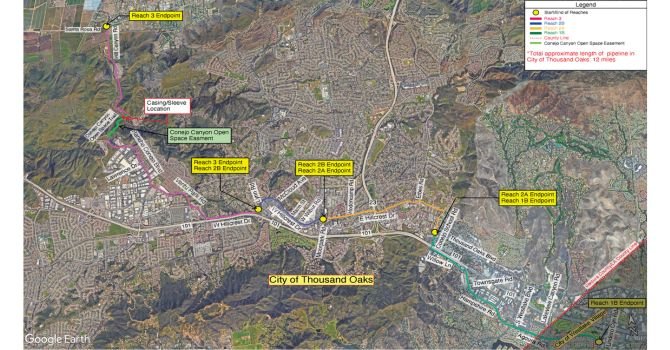
While the purification facility itself is being built in Agoura Hills, Thousand Oaks residents will also see direct impacts from the project. One byproduct of the reverse osmosis purification process is concentrated saltwater waste known as “brine.” To transport that brine safely for disposal, the JPA will construct a regional pipeline running from Westlake Village through Thousand Oaks and into Newbury Park, where it will connect to the existing Calleguas Salinity Management Pipeline that ultimately carries the brine to an ocean outfall near Port Hueneme.
Construction activity (and potential traffic) is expected along portions of:
West Hillcrest Drive
Lynn Road
North Moorpark Road
Rancho Conejo Boulevard
Potential Benefits for Conejo Valley Homeowners & Community
1. Greater Long-Term Water Security
Perhaps the most important benefit is improved drought resilience.
Water shortages and mandatory conservation measures have become increasingly common across California, and communities with stronger local water infrastructure may be better positioned long-term.
Reducing dependence on imported water could help stabilize supply reliability during future drought cycles.
2. Environmental Sustainability
The project is also being promoted as an environmentally responsible alternative to older proposals that included building dams and reservoirs in environmentally sensitive areas of the Santa Monica Mountains.
Instead of releasing excess treated water into Malibu Creek during winter months, the new facility will recycle and reuse that water locally.
Supporters say this helps reduce strain on imported water systems while also lowering energy demand associated with transporting water across California.
3. Protection of Regional Property Values
In California real estate markets, water reliability is becoming increasingly tied to long-term housing stability and community desirability. Communities investing in sustainable infrastructure may ultimately be viewed more favorably as homeowners and buyers become increasingly aware of issues involving:
drought resilience,
wildfire risk,
insurance availability,
utility infrastructure,
environmental planning,
and long-term sustainability.
4. Economic Advantages for Local Industry
City officials have also noted that biotech and advanced manufacturing companies in Thousand Oaks may eventually benefit from the regional brine disposal system rather than relying on trucking industrial waste materials out of the area. That could support future economic growth in the Conejo Valley’s biotech corridor.
Potential Drawbacks & Community Concerns
1. Multi-Year Construction Impacts
For many residents, the most immediate concern will likely be traffic disruptions and road construction. Lane closures, detours, temporary access limitations, construction noise, and traffic delays are expected during portions of pipeline installation throughout Thousand Oaks and Newbury Park.
2. Questions About Ocean Disposal
As with many reverse osmosis and desalination-related projects, some environmental concerns remain regarding the disposal of concentrated brine into the Pacific Ocean, even through regulated infrastructure systems.
3. Future Water Costs
Large-scale public infrastructure projects often raise questions about future water rates and operational costs. While officials emphasize the long-term benefits of water reliability, some residents may wonder how construction and maintenance expenses could affect future utility bills.
4. Temporary Neighborhood Perception During Construction
Visible infrastructure work can temporarily create concerns among homeowners and buyers in affected neighborhoods, particularly near active construction corridors. However, these impacts are considered temporary and localized.
Could This Impact Future Real Estate Disclosures?
At this time, there does not appear to be any official requirement for the purification facility or brine pipeline to become a standardized Ventura County or Los Angeles County real estate disclosure item.
However, there are considerations homeowners and buyers should understand.
If a property is directly and materially affected by easements, access issues, or infrastructure work, those conditions could potentially become relevant during a real estate transaction especially if they are more than temporary.
Across California, buyers are paying closer attention to issues involving:
drought resilience,
wildfire risk,
insurance availability,
utility infrastructure,
environmental planning,
and long-term sustainability.
As these topics become more important statewide, conversations surrounding water infrastructure may increasingly become part of buyer due diligence.
What This Means for Conejo Valley Real Estate
For most homeowners throughout Agoura Hills, Westlake Village, Thousand Oaks, Calabasas, and surrounding communities, this project is unlikely to negatively impact long-term property values. In fact, many real estate and infrastructure experts view investments in water sustainability as critical to preserving long-term quality of life and economic stability in Southern California.
While temporary construction impacts may affect certain corridors over the next few years, the broader goal of securing a more reliable local water supply could ultimately strengthen the region’s long-term desirability.
As always, understanding how major infrastructure projects affect neighborhoods, future development, and buyer perception is an increasingly important part of navigating today’s real estate market.
If you have questions about how this project could impact your neighborhood, property value, or future resale potential, the Lydia Gable Realty Group is here to help.