The housing market is entering a new chapter in 2026 — one defined less by extremes and more by balance. After several years of pandemic-driven volatility, shifting mortgage rates, affordability challenges, and uneven inventory, the real estate landscape is beginning to stabilize.
This 2026 Housing Market Outlook is designed to help buyers, sellers, and homeowners better understand where the market is headed and how to plan confidently for the year ahead.
Four Key Housing Market Signals to Watch in 2026
Understanding the direction of the market starts with tracking the fundamentals. Here are four of the most important indicators shaping real estate in 2026:
1. Housing Inventory Is Shifting
Nationally, buyers may benefit from approximately 10% growth in the number of homes coming to market. More inventory means more choice, less urgency, and greater negotiating power — restoring balance between buyers and sellers, particularly compared to the ultra-competitive conditions of recent years.
Locally, we already saw this type of inventory growth throughout 2025, as well as the effect it had on prices and market balance. As of December 2025, inventory has decreased approximately 20% from Q3 of 2025 at its peak. We anticipate similar inventory levels for 2026.
Source: Keeping Current Matters / BAM (Building A Better Agent)
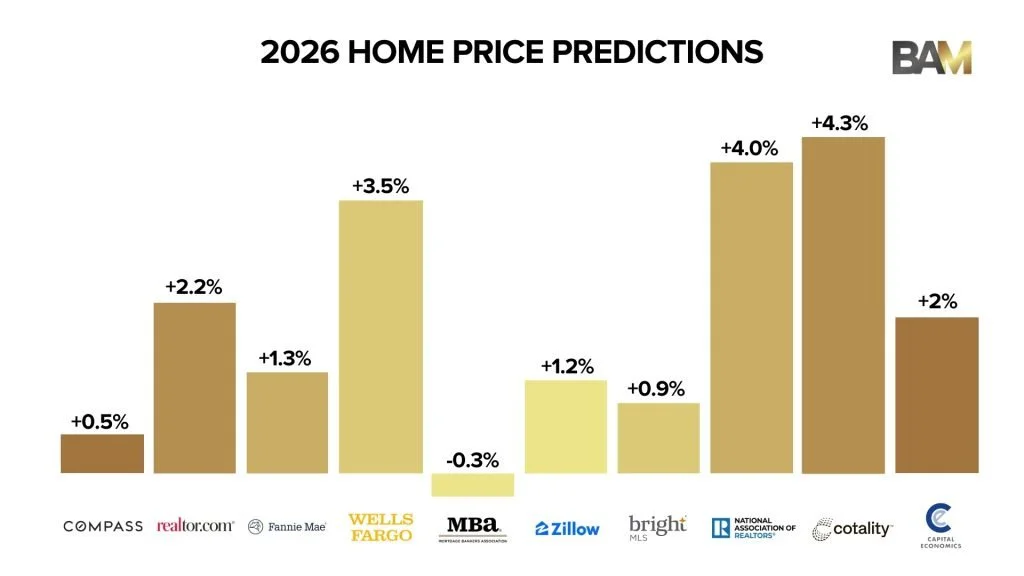
2. Home Prices Are Expected to Level Out
After years of sharp appreciation, home prices are projected to rise modestly — around 0.5% in 2026. While prices may continue to edge upward, income growth is expected to outpace price growth, a combination that supports improved affordability.
This environment favors both buyers seeking stability and sellers who are pricing realistically based on current market conditions.
Source: Keeping Current Matters / BAM (Building A Better Agent)
3. Mortgage Rates Are Becoming More Predictable
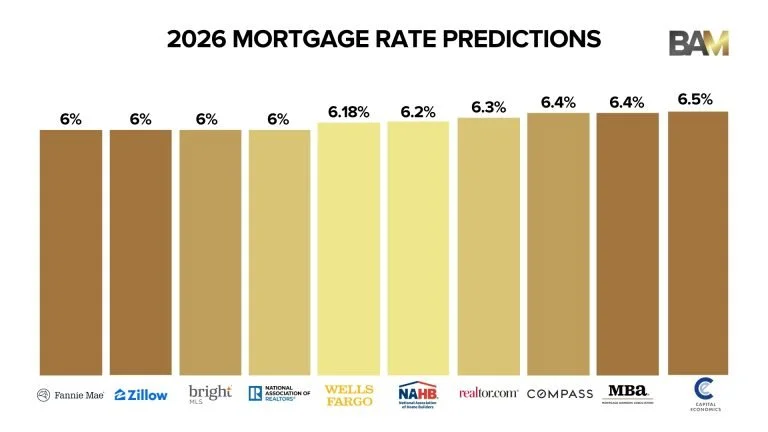
Mortgage rates are forecasted to trade within a range of 5.9% to 6.9%, averaging approximately 6.4% for the year. We are also seeing qualified buyers getting rates in the mid and lower 5% range, depending on terms.
While higher than the historic lows of the past, this range represents a more stable and predictable financing environment — helping buyers plan and reducing the “rate shock” that sidelined many households in prior years.
Source: Keeping Current Matters / BAM (Building A Better Agent)
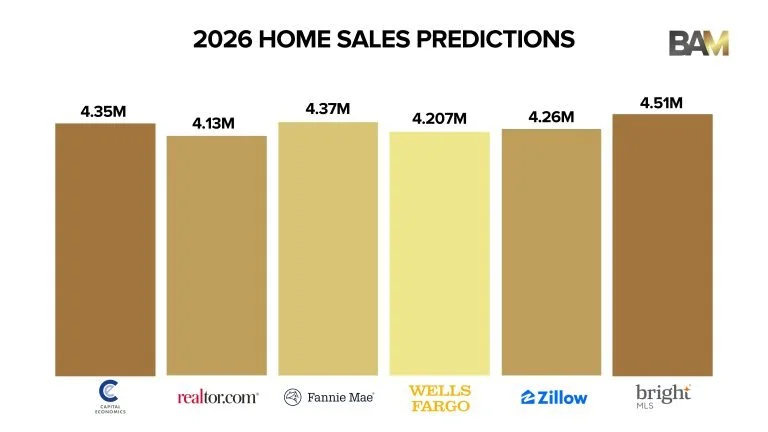
4. Home Sales Are Poised to Increase
With rates easing and inventory improving, home sales could reach approximately 4.25 million transactions, representing a 5% increase from 2025.
This growth reflects renewed confidence among buyers and sellers who postponed moves during periods of uncertainty and are now re-entering the market.
What This Means for Buyers and Sellers
Taken together, these trends point to a housing market that is healthier, more balanced, and better aligned with long-term fundamentals.
Buyers may find more options, less competition, and improved affordability.
Sellers can expect steady demand, particularly when homes are priced and prepared correctly.
Homeowners gain clarity and stability when planning future moves or investment decisions.
For anyone considering a move in 2026 or beyond, the momentum across key housing metrics suggests growing opportunity and a return to confidence-driven decision-making.
A Closer Look at the Local Market — Conejo Valley
While national housing trends provide helpful context, real estate decisions are ultimately local. In Conejo Valley (Westlake Village, Thousand Oaks, Agoura Hills, Oak Park, Newbury Park), market dynamics continue to reflect a blend of long-term desirability, limited land for new construction, and strong demand driven by lifestyle, schools, safety, and proximity to Los Angeles.
In 2026, we expect:
Slightly higher and continued demand for single-family homes, particularly those with larger lots or updated interiors
Stable pricing supported by limited resale inventory
A more balanced negotiation environment compared to the peak seller’s market years
Homes that are priced correctly and well-prepared are likely to attract serious buyers.
Westlake Village continues to attract move-up buyers, relocations, larger families, and downsizers seeking a blend of luxury, walkability, and access to top-rated schools. With mortgage rates stabilizing, many buyers who paused plans in prior years are re-entering the market with renewed confidence.
Key trends to watch locally include:
Steady interest in gated communities and lake-adjacent properties
Strong demand for turnkey homes as buyers prioritize convenience
While price growth may be modest in 2026, Westlake Village’s desirability helps protect values during market transitions.
Thousand Oaks continues to serve as an important entry point for buyers looking to establish long-term roots in the Conejo Valley. Compared to some neighboring communities, Thousand Oaks offers a wider range of housing styles, price points, and neighborhood options.
Looking ahead:
Increased activity among first-time buyers, and Amgen employees due to their $600m expansion
Consistent demand in family-friendly neighborhoods near schools and parks
Growing interest from buyers relocating from higher-cost coastal and urban markets
Across Westlake Village, Thousand Oaks, Agoura Hills, and Oak Park, the 2026 market is shaping up to be one defined by realistic pricing, thoughtful preparation, and informed strategy.
Timing, micro-market trends, and neighborhood nuances matter more than ever. Working with a local expert who understands these subtleties can make a meaningful difference in outcome.
Navigating the 2026 Market with Confidence
As local real estate market experts, our role is to help you interpret these trends through a hyper local lens — identifying how they impact your specific neighborhood & street, your home value, and your goals.
If you’re thinking about buying, selling, or simply planning ahead, understanding the direction of the market is the first step toward making informed decisions in 2026.
* This outlook is based on internal Compass data and insights compiled by Altos Research. Market forecasts are speculative and subject to change.